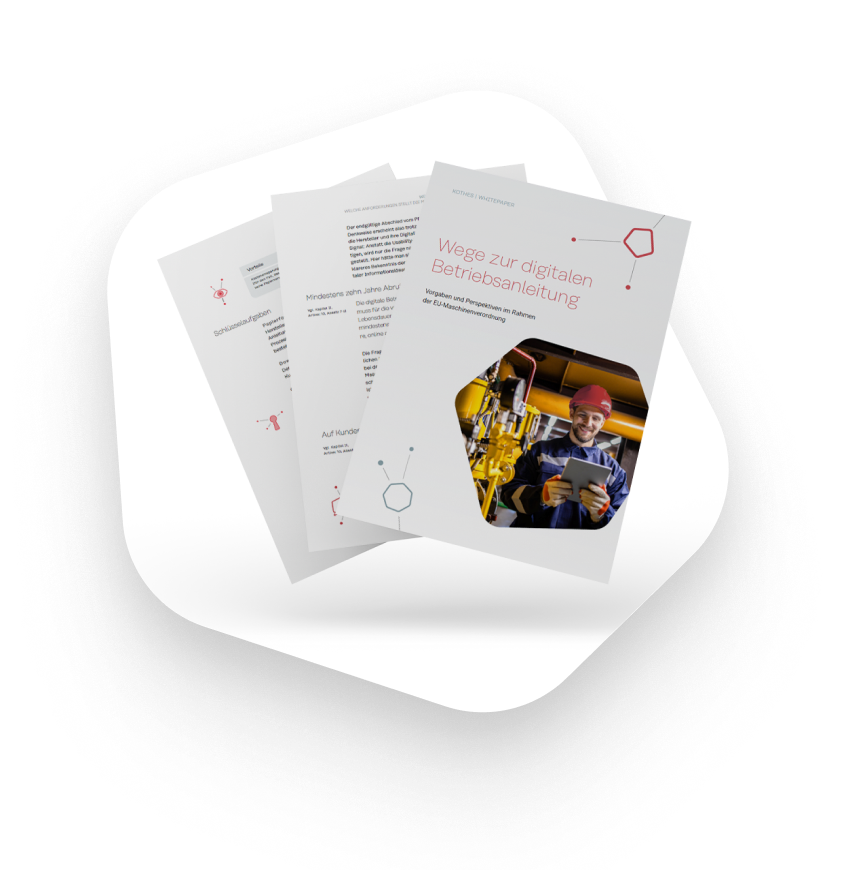


The right component content management system for your technical documentation
Find the right component content management system for technical documentation: CCMS selection, implementation and integration.
This is the right place for you

if you are still creating your technical documentation in individual files and would like to introduce a suitable content management system.

if you reach your limits with many products, languages and variants and would like to reuse content efficiently.

if you need to change your existing CCMS because it no longer meets your requirements or is no longer being developed.
if you would like to integrate tools for risk assessments or a content delivery portal into your system landscape in a meaningful way.

Typical challenges
Creating technical documentation efficiently with the right system
As products, variants and languages multiply, individual files become unmanageable. Content is duplicated, changes are scattered and approved versions are hard to track.
A CCMS can reuse content modules centrally, but only if it fits your information structures, approval processes and publication channels.
Start with the questions: What should be reused? How are variants managed? Who works in the system?
Supplementary tools must work together within one coherent system.
Benefit from our experience and let a new system make your technical documentation a success
We support you with selection, implementation and successful use





Which project size suits your needs?
Compact introduction
Simple CCMS for limited requirements
Suitable for:

few products and variants
small writing team
clearly defined publication channels
quick start
Typical scope:
prioritise requirements
select a suitable system
set up basic structure
train the team
Growing writing teams
Standard solution for many products and variants
Suitable for:
many products and variants
multiple languages and markets
structured and reusable content
shared workflows
Typical scope:
system selection and information model
roles and approvals
interfaces
introduction and operation
Complex organisations
Enterprise solution for individual requirements
Suitable for:
large or decentralised writing teams
individual processes
complex roles and permissions
multiple locations or authoring languages
Typical scope:
requirements model and system configuration
migration and interfaces
roles and permissions
introduction, training and operation
Recognised by customers, employees and industry bodies alike
We are certified to ISO 9001, ISO 17100 and ISO 18587, meeting internationally recognised standards for quality management, translation services and post-editing of machine translation.
Our customers rate us 9.2 out of 10. This score reflects our commitment to building strong partnerships and delivering reliable service.
We follow automotive industry standards and actively invest in data protection, information security and availability.

Our employees rate kothes highly, well above the average. This reflects our positive company culture and the quality of our working relationships.
tekom Germany has honoured us with its Documentation Award (Dokupreis) on several occasions for outstanding technical documentation projects.
We are certified to ISO 9001, ISO 17100 and ISO 18587, meeting internationally recognised standards for quality management, translation services and post-editing of machine translation.
Our customers rate us 9.2 out of 10. This score reflects our commitment to building strong partnerships and delivering reliable service.
We follow automotive industry standards and actively invest in data protection, information security and availability.
Our employees rate kothes highly, well above the average. This reflects our positive company culture and the quality of our working relationships.
tekom Germany has honoured us with its Documentation Award (Dokupreis) on several occasions for outstanding technical documentation projects.